By Max Spitzer
What the modern House Member desires most of all is certainty of schedule. Members are incredibly busy, pulled in every conceivable direction, and an unpredictable, chaotic floor schedule is a nightmare for them. So, over the past 30 years, the House has slowly imbued the Speaker with more and more power to unilaterally set the schedule for the convenience of Members.
We have now come to its logical conclusion: a House where only the Speaker can decide when it will be in session.
It began innocently enough when a majority of legislators gave the Speaker the authority to declare a short, temporary recess of the House. Prior to this change in 1993, the House would have to formally authorize each recess – an inefficient process that could lead to obstruction. At around the same time, the House gradually expanded the power of the Speaker to postpone and “cluster” votes, so that Members could dispose of a “stack” of postponed votes, rather than needing to come to the floor multiple times over the course of the day.
The next phase of the growth of the Speaker’s power to convene or adjourn the House also had benign origins: concern over continuity of operations following 9/11. Members worried the House had little flexibility to respond to circumstances if a terrorist attack “impaired” the place of convening. Thus, the Speaker was given authority to bring the House in or out of session, or even move the place of convening, if emergency circumstances warranted such actions.
But the next phase involved purely political considerations and oddly enough began in the Senate. Concerns over the President’s abuse of recess appointment authorities (i.e. the ability to fill temporary appointments without Senate consent when the Senate is not in session) prompted a defensive maneuver. The Senate would defeat this executive aggrandizement by simply refusing to adjourn for any significant length of time. But this decision had a major ramification for the House. The Constitution requires joint House and Senate action for any adjournment of more than three days, so if the Senate wants to meet every three days rather than actually adjourn, the House has little choice but to follow suit.
As this new never-truly-adjourning reality of the 2010s set in, the House needed to arrange for business-less pro forma sessions every three days if Members ever wanted to go back to their districts for anything more than a weekend. Nothing distinguishes pro forma sessions from regular sessions, other than the fact that Members have given tacit permission for the Chair to gavel in and gavel out quickly, with no business conducted and no possibility of votes. If everyone’s on board with the plan (and obviously Members of both parties want time back home), there are no issues.
But Members have the right to demand votes in a variety of circumstances, and if some Members are not on board with the plan, a pro forma session has the potential to invite mischief. For example, the constitutionally-mandated Journal of the House needs to be approved at each session, which can occur automatically – unless someone objects and demands a vote. And if a group of Members chose to attend an empty pro forma session, they could defeat the motion to adjourn and threaten to start doing legislative business.
The solution (used by both parties) was to fully empower the Speaker to prevent any parliamentary shenanigans. The House would let the Speaker dispense with any and all legislative business (i.e. deny recognition to any Member attempting to call up a bill). The Journal would be automatically approved, without the possibility of a vote. And the Speaker would be given the power to unilaterally adjourn the House and reconvene it sometime before the constitutional three-day limit. These extraordinary authorities were first granted on an ad hoc basis. The House would come to a scheduled break, where Members could return to their districts, and a resolution from the Rules Committee would empower the Speaker in the ways described above for the duration of the break.
In the 118th Congress (2023-2024), what had previously been ad hoc authorities were converted into standing authority of the Speaker, and in this Congress, these authorities were formally established in the standing rules themselves: Rule I, clause 13. Now, the Speaker does not have to wait for the Rules Committee to make a specific authorization for a specific time period. The rules give the Speaker the power to designate any time period as a “district work period.” And during any “district work period,” the Speaker has unilateral authority to bring the House into session and take the House out of session (the only limit being that, per the Constitution, he has to do so every three days).
The trajectory here is easy to understand. Good faith efforts to make the schedule more efficient and to provide for emergency contingencies, led Members to trust the Speaker with more and more scheduling power. And in what has become a familiar procedural pattern, fear of shenanigans instigated by the minority party (or some rogue Member) provided the rationale for giving the Speaker absolute power – power that, when it is exercised, does not require the affirmative consent of a majority of the House and cannot be challenged.
Needless to say, this is not how healthy legislatures operate. Parliamentary bodies do not cede their ability to conduct business to the whims of a single individual. Doing so returns us to the bad old days of absolute monarchs proroguing parliaments (repeatedly dissolving “Representative Houses” was one of the complaints levelled at George III in the Declaration of Independence). It bears emphasizing that there are no limits articulated in Rule I, clause 13. Speaker Mike Johnson (R-LA) initially declared the current “district work period” as ending on September 28. But he has extended it six times since then, and he could extend it into the future indefinitely. Indeed, there is nothing preventing Speaker Johnson from declaring that the remainder of the 119th Congress shall be a “district work period” and the House will not be taking any more votes until 2027. It’s hard to even argue that this is an abuse of authority because the House has given him limitless power and he would simply be taking things to their logical endpoint.
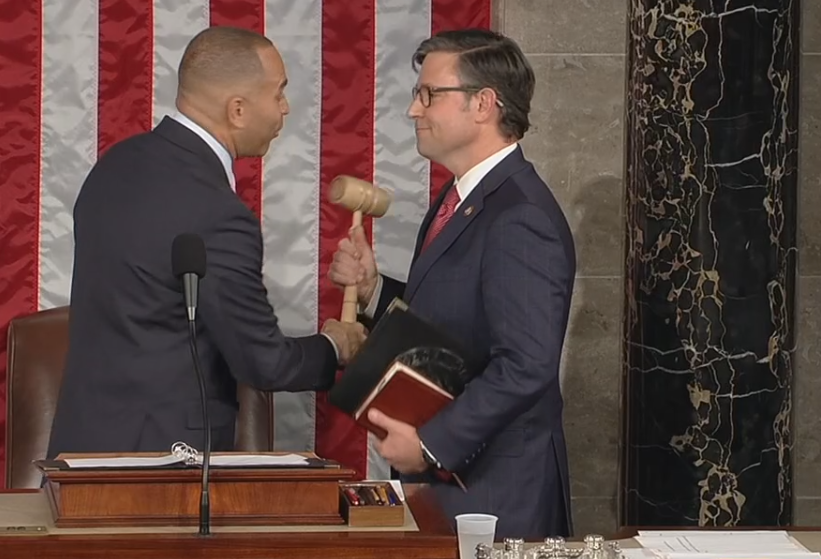
The House has tied itself in a parliamentary knot that is not easily cut. Even if a large majority of the House wanted to conduct business and showed up at the next “pro forma” session determined to defy Johnson, what could they do? The Speaker has been authorized to deny recognition to any Member, he can take actions that are not subject to appeal, and he can unilaterally end the session whenever he wants. Members could yell, stamp their feet, gnash their teeth, but the moment Speaker Johnson decides to bang the gavel, the session is over.
With no effective parliamentary means for regaining control of the House, a defiant majority’s only recourse would seem to be shame: gather a majority on the floor of the House during a pro forma session, demand that the Speaker open a real session of the House, and stay there until he does. If he refuses, I don’t see another option than for that majority to declare itself the actual House of Representatives and proceed to the election of a new Speaker (it goes without saying that such extraordinary action would not be without controversy and would probably be subject to legal challenge).
If the House is ever able to regain control of its proceedings, it should immediately repeal Rule I, clause 13. Failing to do so would leave the House at the mercy of the arbitrary whims of the Speaker.
Max Spitzer is a parliamentary consultant and former staff of the Parliamentarian’s Office at the U.S. House of Representatives. In his nearly 20-year career on the Hill, he served as an Assistant Parliamentarian on the House floor and Managing Editor of the House Parliamentarian’s publications office.
Stay in the know about our news and events.