President Donald Trump’s first year of his second, nonconsecutive term brought all sorts of changes. His administration shuttered the United States Agency for International Development, had the government acquire stakes in Nvidia and several other corporations, and dispatched the National Guard to patrol Washington, D.C., and other major cities, to cite only a few examples.
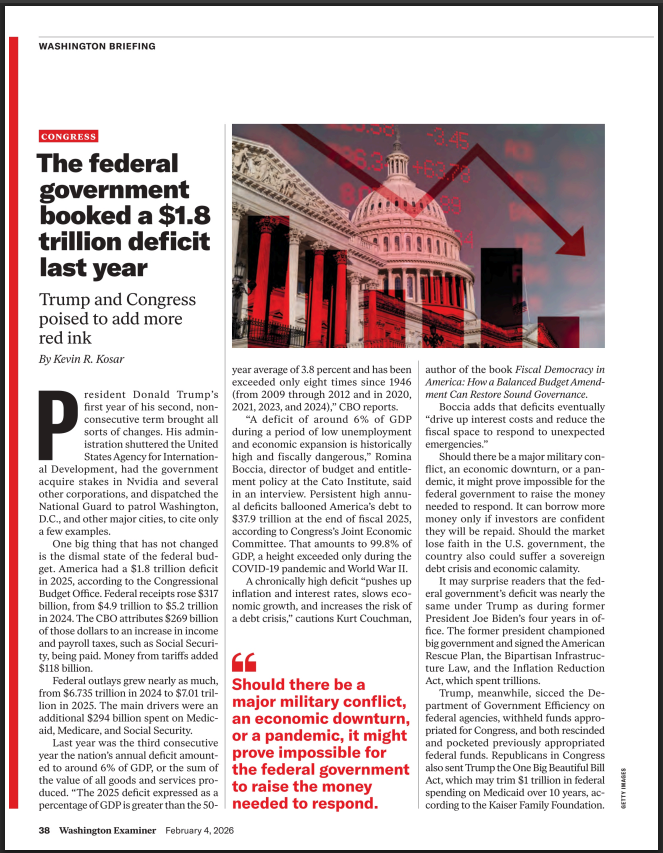
One big thing that has not changed is the dismal state of the federal budget. America had a $1.8 trillion deficit in 2025, according to the Congressional Budget Office. Federal receipts rose $317 billion, from $4.9 trillion to $5.2 trillion in 2024. The CBO attributes $269 billion of those dollars to an increase in income and payroll taxes, such as Social Security, being paid. Money from tariffs added $118 billion.
Federal outlays grew nearly as much, from $6.735 trillion in 2024 to $7.01 trillion in 2025. The main drivers were an additional $294 billion spent on Medicaid, Medicare, and Social Security.
Last year was the third consecutive year the nation’s annual deficit amounted to around 6% of GDP, or the sum of the value of all goods and services produced. “The 2025 deficit expressed as a percentage of GDP is greater than the 50-year average of 3.8 percent and has been exceeded only eight times since 1946 (from 2009 through 2012 and in 2020, 2021, 2023, and 2024),” CBO reports.
“A deficit of around 6% of GDP during a period of low unemployment and economic expansion is historically high and fiscally dangerous,” Romina Boccia, director of budget and entitlement policy at the Cato Institute, said in an interview. Persistent high annual deficits ballooned America’s debt to $37.9 trillion at the end of fiscal 2025, according to Congress’s Joint Economic Committee. That amounts to 99.8% of GDP, a height exceeded only during the COVID-19 pandemic and World War II.
A chronically high deficit “pushes up inflation and interest rates, slows economic growth, and increases the risk of a debt crisis,” cautions Kurt Couchman, author of the book Fiscal Democracy in America: How a Balanced Budget Amendment Can Restore Sound Governance.
Boccia adds that deficits eventually “drive up interest costs and reduce the fiscal space to respond to unexpected emergencies.”
Should there be a major military conflict, an economic downturn, or a pandemic, it might prove impossible for the federal government to raise the money needed to respond. It can borrow more money only if investors are confident they will be repaid. Should the market lose faith in the U.S. government, the country also could suffer a sovereign debt crisis and economic calamity.
It may surprise readers that the federal government’s deficit was nearly the same under Trump as during former President Joe Biden’s four years in office. The former president championed big government and signed the American Rescue Plan, the Bipartisan Infrastructure Law, and the Inflation Reduction Act, which spent trillions.
Trump, meanwhile, sicced the Department of Government Efficiency on federal agencies, withheld funds appropriated for Congress, and both rescinded and pocketed previously appropriated federal funds. Republicans in Congress also sent Trump the One Big Beautiful Bill Act, which may trim $1 trillion in federal spending on Medicaid over 10 years, according to the Kaiser Family Foundation.
Yet the federal deficit is going to keep rising. There are a few reasons why.
Part of the problem is legislative. Trump has not used the legislative process to lower federal spending measurably. Trump’s signature legislative achievement, the One Big Beautiful Bill Act, included tax cuts and large spending increases for border control and national defense. CBO estimates the law will add $3.4 trillion in deficits by 2034. The Tax Foundation, a Washington, D.C., think tank that has studied taxation for the better part of a century, attributes $3 trillion in red ink to the bill.
Additionally, the president has signed continuing resolutions and spending bills that continue the Biden administration’s high spending levels. The lone rescission enacted by Congress at his behest cut a mere $9 billion, and Trump’s unilateral rescission in late September will save no more than $4.9 billion.
And speaking of unilateralism, DOGE and the various presidential impoundments of federal funds have not improved the country’s finances. In many instances, the Trump administration’s refusal to spend lawfully appropriated money has been stymied by legal challenges or reversed due to congressional or public outcry.
The downsizing of the federal civilian workforce is a case in point. Maybe DOGE’s pushing out of 335,000 employees will save some money in the coming years. But maybe not. Many of these employees retired, which means they will draw costly federal benefits. Additionally, Trump’s successor can fill these jobs unless Congress sends Trump legislation to eliminate them permanently.
There are few signs that the White House or Capitol Hill is serious about reducing federal deficits. Trump is talking of acquiring Greenland and calling for a $600 billion increase in defense spending. Republicans, who control both chambers of Congress, continue to send the president appropriations bills that spend more than last year’s laws. Democrats have urged aggressively raising taxes on the wealthiest Americans. Done properly, well-targeted tax increases would at best slow the growth of the deficit.
And hardly any public official in Washington, D.C., is trying to fix the biggest drivers of national deficits.
“Mandatory spending programs — particularly Social Security, Medicare, and Medicaid — along with rising [debt] interest costs, account for the bulk of projected spending growth,” Boccia explained. “Without legislative reforms to these programs, executive actions cannot materially change the deficit outlook.”
Kevin R. Kosar (@kevinrkosar) is a senior fellow at the American Enterprise Institute and edits UnderstandingCongress.org. This piece previous was published by the Washington Examiner.
Stay in the know about our news and events.