

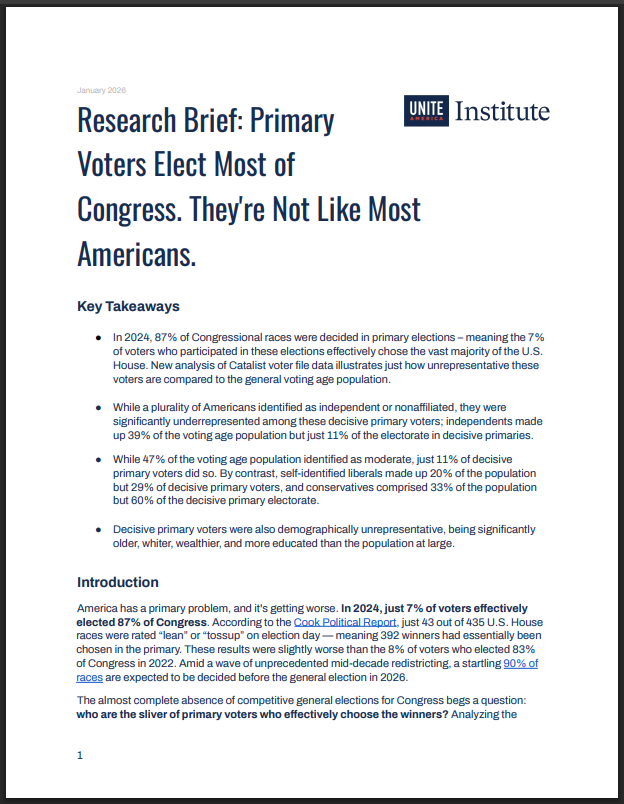
Unite, Research Brief: Primary Voters Elect Most of Congress. They’re Not Like Most Americans, January 2026.
More than a century ago states began to implement primaries to choose senators and members of the House of Representatives. This was a reform aimed at making the selection of party candidates more democratic—no longer would they be selected by party bosses or party advocates attending caucuses or conventions.
No reform is perfect, and primary elections have been drawn much criticism in recent years. One charge against them is that the voters who participate in them are atypical, hence, the candidates that win them either are overly leftwing or rightwing in their views and overly concerned with pleasing these voters.
This research brief adds evidence to the charge of primary voter atypicality.
In 2024, 87% of House races were determined in primary elections, meaning that just 7% of voting‑age Americans —“decisive primary voters” as this brief terms them— effectively chose most members of Congress. Thus, for example, if a congressional district has 50 percent of voters who reliably vote for Democrats, 30 percent who consistently vote for Republicans, and 10 percent who can go either way, the candidate who wins the Democratic primary almost inevitably will win the general election.
The memo’s authors drew data from the Catalist voter file to compare decisive primary voters in uncompetitive districts to the general voting‑age population. They focused specifically on voters who participated in the dominant party’s primary (e.g., the Democrats in the example above). This methodological choice isolates the subset of voters who actually determine outcomes in districts where the general election is not competitive.
The findings show that decisive primary voters differ sharply from the broader population across both partisan/ideological and demographic dimensions.
Stay in the know about our news and events.