


Nowadays people complain about the tedious pace of Senate business. The upper chamber empowers the minority party and even a single senator to delay measures indefinitely. Chief among these tactics is the filibuster, which mandates in many cases the majority party must have 60 votes to move to a final vote. That is a tough hurdle to overcome.
Not so in the House. The majority party has total control over the business of the lower chamber — from deciding the business of the floor to assigning seats on committees, it dictates what the House will consider.
But it was not always this way. In the late 19thcentury, the House had rules that empowered the minority to delay business in similar ways to the contemporary Senate.
One man more than any other is responsible for unwinding those rules — Thomas Brackett Reed, who served as Speaker of the House from 1889-90 and 1895-1899. An interesting character in his own right, Reed’s transformation of the House into a wholly majoritarian chamber make him an icon of Congress.
Thomas Brackett Reed was born in 1839 in Portland, Maine. He graduated from Bowdoin College in 1860, and joined the Navy in 1864, serving as an assistant paymaster aboard the gunboat USS Sybil. By 1864, the Mississippi had been pacified, and the Sybil recorded no incoming fire during Reed’s service. After the war ended, Reed returned to Portland and became a lawyer. He entered Maine politics and quickly advanced through the ranks, winning election to the state house in 1867, the state senate in 1869, the attorney generalship in 1870, and a seat in the United States House of Representatives in 1876.
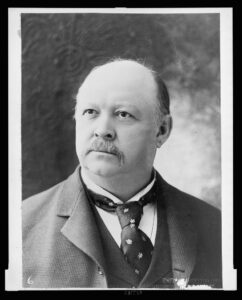
Reed cut an impressive figure. Measuring over six feet tall and weighing over 300 pounds, he was much larger than the average American, both then and now. He had a biting wit and a fierce integrity; the latter trait cut against the grain of American politics in 1876. This was the age of Republican political machines. Facilitated by the indulgent patronage policies of President Ulysses S. Grant, bosses like Senator Simon Cameron of Pennsylvania and Senator Roscoe Conkling of New York dominated their states and exerted massive influence over the national party. Reed was not from the patronage school of thought. To a degree, he carried on the legacy of Alexander Hamilton and Henry Clay — active government involvement in economic development, particularly through the gold standard and protective tariffs. He likewise supported women’s suffrage and voting rights for African Americans.
A major rival within the GOP for Reed was James G. Blaine — the “plumed knight,” as famed orator Robert Ingersoll had called Blaine when he nominated him for president in 1876. Blaine was no friend of the machine bosses, but himself had acquired the taint of corruption through his financial dealings with the railroads. Reed detested Blaine’s apparent use of political power to enrich himself. And while the two were contemporaries at the height of their careers — Blaine was secretary of state from 1889 through 1892, while Reed was leader of the House Republican Conference (succeeding Blane, in fact) — they were not allies.
Reed’s ascent through the Republican Conference was due to his strong will, careful cultivation of political relationships, reputation for integrity, and mastery of House procedures. Though Republicans typically held the presidency during the second half of the 19th century, control of the House frequently oscillated between Democrats and Republicans.
Democrats won the chamber when Reed joined in 1877 and held it for most of the next 20 years. Reed was elected speaker following the Republican triumph of 1888, defeating future president William McKinley for the job, but the Democrats retook the House in the 1890 midterm. Two years after the Panic of 1893 Republicans reestablished congressional dominance, which continued until 1913. When the GOP took the House in 1895, Reed was again elected its speaker, a job he held until 1899.
Reed did away with the rules of the previous House and established “Reed Rules,” which empowered him to make committee assignments, improved the legislative calendar, and curbed the ability of the minority to delay House business.
A key dilatory tactic for the minority was the “disappearing quorum.” The Constitution (Article I, Sec. 5) requires that a majority of members be present for the House to conduct any business. But the old rules of the House counted a member as present only if he answered affirmatively during a quorum call. So, the minority had a tool of obstruction: suggest the absence of a quorum, force a roll call vote, and refuse to answer. They could, in effect, filibuster House business. Reed famously destroyed this tactic on January 29, 1890, just a few weeks after he became speaker. When Democrats demanded a roll call, Reed ordered the House clerk to record those members who were present but silent. Democrats protested, but the Republican majority backed his innovation, and the vanishing quorum was no more.
“Czar” Reed, as he was nicknamed, sought the Republican nomination for president in 1896, but McKinley and his crafty chief organizer, Marcus Hanna, outmaneuvered him. Though he served as speaker for the next several years, Reed’s anti-imperialism strained his relationship with his own party. He opposed the Spanish-American War as well as American efforts to annex Hawaii and the Philippines. He resigned the speakership and his seat in 1899. He spent the remainder of his life as a lawyer in New York, where he died in 1902.
Reed’s career is a fascinating reflection of his time — pro-business but anti-corruption and anti-imperialism, he rose and fell within a Republican Party that had substantial divisions within itself. But his lasting influence is in his alteration of the House rules. By doing away with the vanishing quorum, and in general streamlining floor procedures, Reed established the fundamental character of the modern House: the majority party controls the floor for its own purposes.
Jay Cost is the Gerald R. Ford senior nonresident fellow at the American Enterprise Institute and the author of Democracy or Republic: How the Founders Crafted the Constitution as the Blueprint for Self-Government.
Stay in the know about our news and events.

